
As an Amazon Associate, I earn from qualifying purchases. This article contains affiliate links to products available on Amazon.co.uk. These help support our workshop at no extra cost to you.
Troubleshooting HVLP Orange Peel: The Veteran’s Guide to Mirror Finishes
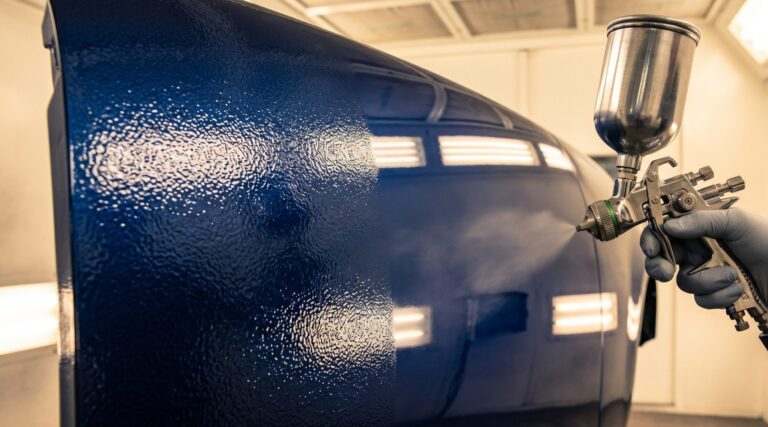
You’ve spent hours prepping that oak tabletop or automotive panel, only to pull the trigger and watch your glass-smooth dreams turn into a dimpled, textured mess. Troubleshooting HVLP orange peel is the rite of passage every finisher faces, but it isn’t a sign of a broken spray gun—it’s a symptom of a physics mismatch.
Quick Answer: How Do I Stop Orange Peel?
Orange peel occurs when paint droplets fail to “flow out” and level after hitting the surface. To fix it immediately: increase your air pressure (atomisation), thin your material with the correct reducer to lower viscosity, or slow your travel speed to allow for a wetter coat. Ensure you are using the correct fluid tip size (typically 1.3mm–1.5mm for clears and 1.8mm+ for primers).
What causes orange peel in HVLP spraying?
The primary cause of orange peel is poor atomisation, where the spray gun fails to break the liquid into a fine enough mist to coalesce into a flat film. When droplets are too large or the solvent evaporates too quickly, the paint “skins over” before it can level, leaving the characteristic dimples of an orange skin. This is usually a tug-of-war between fluid viscosity, air cap pressure, and ambient temperature.
Guide to Wood Preparation Techniques
How does paint viscosity affect Troubleshooting HVLP Orange Peel?
Paint viscosity is the most common culprit because HVLP (High Volume Low Pressure) systems rely on low air pressure to move material, which struggles to “shred” thick, non-Newtonian fluids. If your coating is too thick, the internal surface tension prevents droplets from flattening out upon impact. Using a Ford #4 or Zahn #2 viscosity cup is the only way to move beyond guesswork and achieve professional results.
Recommended Viscosity and Thinning Ratios
Most UK-based paints, like Farrow & Ball or Johnstones, require thinning by 10-20% when used in a turbine-driven HVLP. Use the table below as a baseline for Troubleshooting HVLP orange peel issues related to material thickness.
| Material Type | Recommended Tip Size | Run Time (Ford #4 Cup) |
|---|---|---|
| Clear Lacquer/Varnish | 1.3mm – 1.5mm | 18 – 22 Seconds |
| Water-Based Enamel | 1.5mm – 1.8mm | 25 – 35 Seconds |
| High-Build Primers | 2.0mm+ | 40+ Seconds |
Top Tool Recommendation: For consistent results, invest in a Viscosity Cup and Stopwatch Set.
What are the best HVLP settings to prevent orange peel?
The best settings balance fluid flow and air volume to ensure total atomisation at the air cap. Start by opening your fan control to the desired width, then adjust the fluid needle until you achieve a “wet” look without sagging. If the finish looks “peppery” or dry, you need more air pressure or less fluid volume.
- Air Pressure (PSI): Ensure your compressor is delivering enough CFM (Cubic Feet per Minute) to maintain the gun’s rated PSI at the cap.
- Fluid Tip Size: Using a tip that is too small for thick paint forces you to increase pressure, which can lead to “bounce-back” and dry spray.
- Fan Pattern: A fan that is too wide for the volume of paint being delivered will result in a thin, dry coat that can’t level.
Pro Tip: If you are using a turbine system like the Fuji Spray Semi-PRO 2, ensure the air filters are clean, as restricted airflow is a primary cause of Troubleshooting HVLP orange peel in portable units.
How does spraying technique influence the finish?
Your physical movement is the final bridge between a textured mess and a factory finish. Most DIYers move too fast or hold the gun too far from the workpiece, causing the paint droplets to partially dry in mid-air (a phenomenon called “dry spray”).
- Distance: Maintain a strict 6–8 inch (15–20cm) distance. Any further, and the solvent flashes off before impact.
- Overlap: Aim for a 50% overlap on every pass to ensure the “wet edge” remains active.
- Speed: Move at a consistent pace—roughly one foot per second. If you see texture, slow down slightly.
[restorationlab.uk: Mastering the 50 Percent Overlap]
Do temperature and humidity cause orange peel?
Yes, environmental conditions in a typical UK workshop or garage can drastically alter your “flash-off” time. High temperatures or draughts cause the top layer of paint to dry before the bottom layer has settled. If you’re spraying in heat above 25°C, consider adding a paint retarder or a “slow” thinner to keep the film open longer. Conversely, high humidity can trap moisture, affecting the coalescence of water-based finishes.
How do I fix orange peel that has already dried?
You fix dried orange peel by “levelling” the surface through mechanical abrasion, essentially sanding off the high spots of the dimples until the surface is flat. Start with P800 or P1000 grit wet-and-dry sandpaper on a soft sanding block. Once the surface is uniformly dull and flat, progress through P1500 to P2000 grits before using a Farecla G3 Liquid Compound to restore the gloss.
Frequently Asked Questions
Why is my HVLP gun spitting?
Spitting is usually caused by a loose fluid nozzle, a worn needle packing, or an air leak in the suction tube. Tighten all connections and ensure the needle is properly lubricated.
Can you get a mirror finish with HVLP?
Absolutely. Achieving a mirror finish requires the perfect “holy trinity”: correct viscosity, adequate air atomisation, and a dust-free environment. Most “show-room” finishes are actually achieved by a slight over-application followed by “cut and polish” stages.
The Final Checklist for a Smooth Finish
Before you pull the trigger on your next project, run through this veteran’s checklist to ensure Troubleshooting HVLP orange peel becomes a thing of the past:
- Viscosity: Timed with a cup, not guessed by sight.
- Filters: Clean air and fluid filters to prevent pressure drops.
- Test Piece: Always spray a scrap board to “read” the fan pattern.
- Solvents: Used the correct reducer for the ambient UK temperature.
For more technical breakdowns on spray equipment and finishing, consult the HSE guidelines on safe spraying practices in the UK.
Ready to upgrade your finish? Check out our curated list of the Best Professional HVLP Guns for 2026.