
Disclosure: As an Amazon Associate, we earn from qualifying purchases. All items, tools, and products recommended in this guide are available for purchase on Amazon UK.
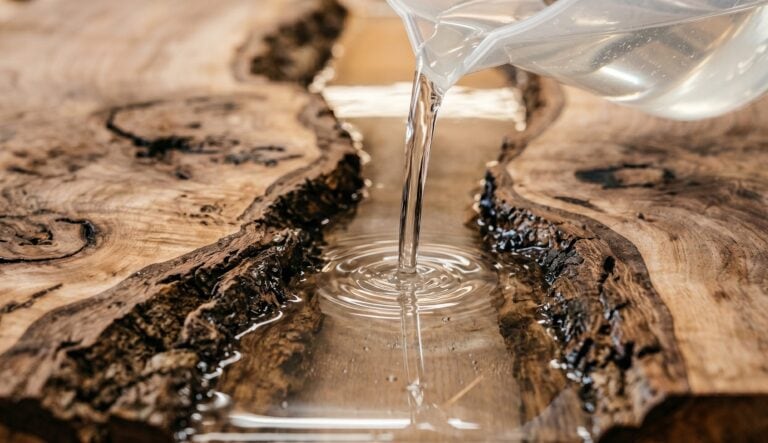
Pouring a live-edge river table is incredibly nerve-wracking. You have likely spent hundreds of pounds on a stunning, kiln-dried slab of English oak or burr walnut. The last thing you want is a disastrous, smoking cure that splits the timber. Finding the best deep pour epoxy resin for river tables uk woodworkers can trust is non-negotiable. Standard coating epoxies simply will not survive a thick pour.
Craft Resin Deep Pour. It delivers a flawless 50mm single pour, features self-degassing low viscosity, and uses a foolproof 2:1 volume mix ratio. For heavy-duty professional workshops handling massive slabs, Resin Pro UK EpoxyTable 5-Five is the superior choice due to its highly scratch-resistant, mechanical cure.Why Standard Epoxy Ruins River Tables (The “Deep Pour” Difference)
Standard tabletop epoxies ruin deep channels because they cure too fast, trap air bubbles, and generate enough heat to literally melt your mould. You must use a specifically formulated deep-cast resin designed for high-volume applications.
Managing the Exothermic Reaction
Deep-pour formulas are engineered to radically slow down the chemical curing process. When two-part epoxy is mixed, it generates heat—an exothermic reaction. If you pour a standard, fast-setting resin 50mm thick, the thermal mass multiplies rapidly. The resin will boil, turn yellow, release toxic smoke, and crack the surrounding wood. Deep-pour resins stagger this heat generation over 48 to 72 hours, keeping the mass cool and stable.
Low Viscosity for Natural Bubble Release
A thin, water-like consistency is critical for a flawless finish. Low viscosity resin allows trapped air bubbles introduced during the mixing process to naturally rise to the surface and pop. High-viscosity (thick) resins trap these bubbles permanently in suspension unless you use an expensive vacuum degassing chamber. Always seal your live edges first to prevent wood fibers from releasing endless micro-bubbles into the liquid channel.
UV Stability and Anti-Yellowing Protections
Epoxy naturally degrades and yellows when exposed to ultraviolet light. Premium resins incorporate advanced Hindered Amine Light Stabilizers (HALS) and UV filters. While no epoxy is 100% UV-proof forever, these chemical additives ensure your crystal-clear river table doesn’t turn an ugly amber hue within the first year of sitting near a sunny window.
The Top 5 Best Deep Pour Epoxy Resins in the UK
We evaluated the leading UK market options based on clarity, maximum single pour depth, degassing ability, and workshop reliability. Here are the elite choices.
1. Craft Resin Deep Pour (Best Overall for Clarity & Ease of Use)
The Craft Resin Deep Pour dominates the UK market by offering the perfect balance between professional-grade clarity and beginner-friendly mixing. It cures to a glass-like, high-gloss finish that rarely requires aggressive polishing.
- Pros: Foolproof 2:1 volume ratio; excellent bubble-free 50mm single pours; highly compatible with liquid epoxy pigment and mica powders.
- Cons: Slightly softer surface cure compared to industrial resins, meaning it requires a good hard wax oil topcoat.
2. Resin Pro UK “EpoxyTable 5-Five” (Best for Professional High-Volume Tables)
Resin Pro UK EpoxyTable 5-Five is the heavy-duty workhorse preferred by commercial furniture makers. It is engineered specifically for massive timber slabs, boasting incredible mechanical strength and scratch resistance once fully cured.
- Pros: Unbeatable structural integrity; very low exothermic heat profile; superior UV shielding.
- Cons: Requires strict mixing by weight (100:55 ratio); longer 72-hour hard cure time slows down production.
3. Res-iT 6L Pro Kit (Best Value for Medium-to-Large Projects)
The Res-iT 6L Pro Kit offers an exceptional cost-to-performance ratio for makers scaling up their operations. It is completely VOC-free, making it safer for enclosed UK garage workshops.
- Pros: Excellent value per litre; odourless and safe to handle; extremely slow cure minimizes shrinkage.
- Cons: Can be sensitive to ambient moisture during the initial mixing phase.
4. Clearcast 50mm Casting Resin (Best for Thick Single-Layer Pours)
Clearcast 50mm Epoxy Deep-Pour is formulated specifically for the British climate. It handles thick, bold 50mm (2-inch) layers with ease, refusing to overheat even when poured in large, concentrated volumes.
- Pros: Ideal for deep, narrow river channels; very forgiving in slightly cooler workshop temperatures; brilliant optical clarity.
- Cons: Premium price point; requires vigorous mixing to combine the thick hardener.
5. Alumilite Amazing Deep Pour (Best Premium Import)
While an American brand, the Alumilite Amazing Deep Pour UK stock is now readily available on Amazon. It is legendary among top resin artists for its flawless color suspension—mica powders won’t instantly sink to the bottom.
- Pros: Holds pigments beautifully; consistent, reliable curing; minimal surface tension issues.
- Cons: Often hit with import-related price fluctuations; stock levels can vary.
Deep Pour Resin Comparison Data
Compare the raw specifications to ensure you buy the exact formulation required for your specific table depth.
| Brand & Model | Max Pour Depth (mm) | Mix Ratio | Hard Cure Time | Average UK Price/Litre |
|---|---|---|---|---|
| Craft Resin Deep Pour | 50mm | 2:1 (Volume) | 48 Hours | £25 – £30 |
| Resin Pro EpoxyTable 5-Five | 50mm | 100:55 (Weight) | 72 Hours | £22 – £28 |
| Res-iT Pro Kit | 50mm | 2:1 (Volume) | 48 – 72 Hours | £18 – £24 |
| Clearcast 50mm Casting Resin | 50mm | 2:1 (Volume) | 48 Hours | £30 – £35 |
| Alumilite Amazing Deep Pour | 50mm | 2:1 (Volume) | 48 – 72 Hours | £35 – £45 |
Crucial Buying Factors for UK Woodworkers
Selecting the resin is only half the battle. Your workshop conditions and preparation methods dictate whether the pour succeeds or ends up in the skip.
Mixing Ratios: Weight vs. Volume Mistakes
Mixing by weight when the manufacturer specifies volume (or vice versa) is the leading cause of soft, tacky resin that never cures. Resins like Craft Resin use a 2:1 ratio by volume—you use a measuring jug. Resin Pro demands a 100:55 ratio by weight—you must use a highly accurate digital scale. Resin and hardener have different specific gravities; assuming 100ml weighs 100g is a catastrophic, expensive error.
Controlling Your UK Workshop Temperature
A damp, cold British garage in November is an epoxy killer. Deep pour resins require a stable ambient temperature—ideally between 18°C and 24°C—for the entire 48-to-72-hour curing cycle. If the temperature drops too low, the resin will turn cloudy (amine blush) and stop curing entirely. Use a space heater with a thermostat.
Furthermore, ensure your timber is bone dry before pouring. Trapped water will violently react with the epoxy. Always test your slabs with the best moisture meter for wood to ensure a reading below 10%.
People Also Ask (PAA)
How deep can you pour epoxy resin for a river table?
Most high-quality deep pour resins allow for a maximum of 50mm (2 inches) per layer. If your river table slab is 75mm thick, you must pour in two staged layers. Pour the first 40mm, wait for it to reach a “b-stage” sticky gel state (usually 24 hours), and then pour the remaining 35mm to avoid overheating.
Why did my deep pour epoxy crack?
Cracking is almost always caused by an uncontrolled exothermic reaction. This happens if you pour standard coating resin too thick, pour a deep-pour resin significantly deeper than the manufacturer’s maximum limit, or leave the curing table in a room that is far too hot, accelerating the chemical reaction beyond its design.
How long does a deep pour river table take to cure?
A hard cure typically takes 24 to 48 hours, meaning it is solid to the touch. However, a full structural cure—where the resin is hard enough to safely machine, plane, or sand with a heavy-duty orbital sander—takes a minimum of 72 hours, and often up to 7 days depending on the workshop’s temperature.
Expert Tips for a Flawless, Bubble-Free River Table
Professional resin artists don’t rely on luck; they rely on meticulous preparation. According to veterans in the field, skipping the sealing phase is the ultimate rookie mistake.
“Never pour deep resin against raw, unsealed live edges. Wood is porous. As the resin heats up, it forces the trapped air out of the timber, creating a relentless fountain of micro-bubbles that will ruin the clarity of your river. Always paint on a thin ‘seal coat’ of fast-setting epoxy 24 hours before the main pour.”
The Golden Rules of River Table Preparation:
- Seal the Edges: Brush a thin layer of tabletop epoxy onto the live edges to lock in the air and seal the bark.
- Clamp Everything: Wood floats in high-density resin. Heavily clamp your timber slabs down to the mould base, or they will lift mid-pour.
- Use Proper Release Tape: Line your melamine mould with high-quality Tyvek or tuck tape. Never use standard masking tape.
- Finish with Quality Oil: Once sanded perfectly flat, finish the wood and resin simultaneously with a premium topcoat. Comparing Osmo vs Fiddes hard wax oil is the best place to start for a durable, professional sheen.
Conclusion & Final Verdict
Choosing the correct chemical formula is the single most important decision you will make in your build. Do not risk hundreds of pounds of premium hardwood on cheap, fast-setting craft epoxy.
The best deep pour epoxy resin for river tables uk professionals rely on is unequivocally Craft Resin Deep Pour for its user-friendly volume mixing and stunning clarity. If you are running a high-volume commercial shop, pivot to Resin Pro UK EpoxyTable 5-Five for its unmatched mechanical durability. Take your time, monitor your workshop temperatures, strictly follow the mixing ratios, and your next river table will be a generational masterpiece.